
Can Wearable Sleep Trackers Really Detect Your Sleep Stages?
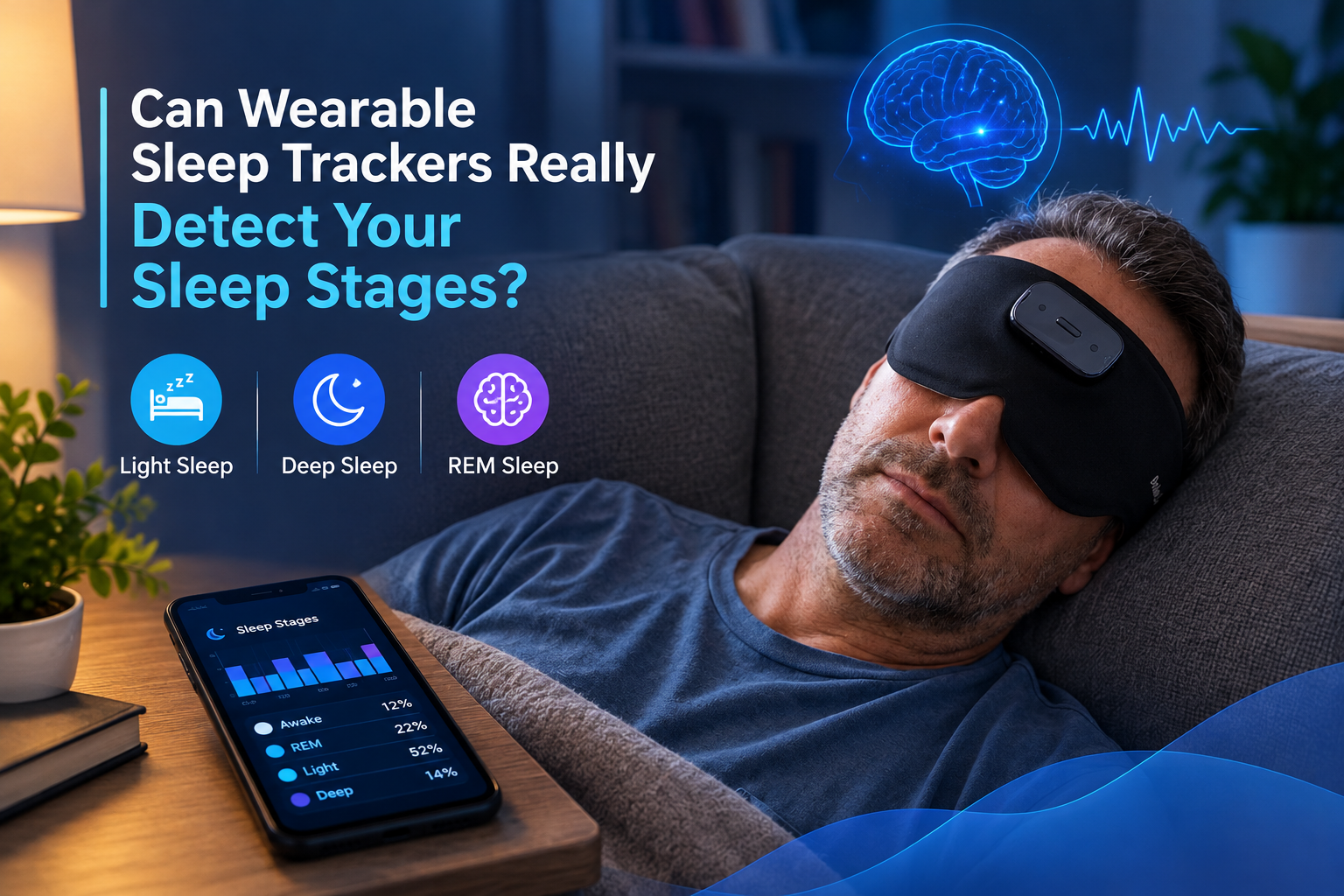
Sleep trackers have become increasingly popular, giving people an easy way to learn more about their nightly sleep. Many smartwatches, rings and wearable devices now provide estimates of sleep stages such as light, deep and REM sleep.
But how accurate are these measurements? Can a wearable really tell when you are asleep, awake or moving between different sleep stages?
What Are Sleep Stages?
Sleep is made up of several stages that occur in repeating cycles throughout the night. These include light sleep, deep sleep and REM (rapid eye movement) sleep.
Each stage is associated with different patterns of brain activity, body movement, breathing and heart activity. Sleep stages are traditionally assessed in a clinical sleep study using polysomnography (PSG), which can monitor brain activity alongside other physiological signals.
Wearable sleep trackers generally use a different approach.
How Do Wearable Sleep Trackers Estimate Sleep Stages?
Most consumer sleep trackers do not directly measure brain activity. Instead, they use sensors and algorithms to estimate sleep patterns from signals such as:
- Movement and body position
- Heart rate
- Heart-rate variability
- Breathing patterns
- Other physiological signals, depending on the device
The device processes this information using algorithms to estimate when you may be awake or asleep and which sleep stage you may be experiencing.
This means that a sleep tracker is generally estimating sleep stages rather than directly measuring them.
How Accurate Are Sleep Stage Estimates?
Wearable devices can provide useful information about overall sleep patterns, but their sleep-stage estimates should not be treated as equivalent to clinical sleep testing.
This is particularly important because different sleep stages can have similar physical characteristics. For example, periods of stillness may occur during several stages of sleep, making it difficult for a consumer device that relies primarily on movement and other indirect signals to determine the exact stage.
Accuracy can also vary between devices, algorithms and individual users.
For everyday use, sleep trackers can therefore be useful for identifying patterns and trends, rather than providing a definitive measurement of every sleep stage.
Why EEG Can Provide Different Sleep Insights?
Brain activity is an important part of identifying sleep stages. EEG (electroencephalography) measures electrical activity in the brain through sensors placed on the scalp.
EEG-based wearable technology can therefore provide a different type of information from trackers that rely mainly on movement or cardiovascular signals.
For example, EEG Wearables can capture brain activity and use that information to provide insights into sleep-related patterns. However, consumer EEG devices should still be understood within their intended use and should not automatically be considered equivalent to a clinical sleep study.
What Should You Look For in a Sleep Tracker?
If you’re considering a wearable sleep tracker, look beyond the number of hours shown on the dashboard. Consider whether the device provides:
- Clear information about how sleep is estimated
- Multiple sensor inputs
- Easy-to-understand sleep trends
- Consistent tracking over time
- Useful insights rather than simply presenting large amounts of data
- Appropriate disclaimers about the technology’s limitations
The goal should be to understand your sleep patterns rather than becoming overly focused on achieving a particular score every night.
Can Sleep Tracking Help You Improve Your Sleep?
Used thoughtfully, sleep tracking can help you become more aware of your routines. You may notice connections between your bedtime, screen use, exercise, daily routine and how you feel the following day.
However, one unusual night does not necessarily indicate a problem. Sleep naturally varies, and wearable estimates can also contain inaccuracies.
Looking at longer-term patterns is generally more useful than judging your sleep based on a single night’s data.
The Bottom Line
So, can wearable sleep trackers really detect your sleep stages?
They can estimate sleep stages, but most consumer devices do not measure them directly in the same way as a clinical sleep study. Their value is often in helping users understand sleep patterns and trends over time.
For those looking to explore sleep tracking through brain-based technology, Easleep by Neuro AI uses EEG technology to provide insights into brain activity during sleep, alongside adaptive sleep audio designed to support a more personalised sleep experience.
Neuro AI makes it easier to explore your sleep patterns through wearable technology, helping you become more aware of your nightly routine and sleep experience. As with any consumer sleep technology, the information is intended for personal insight and should not replace professional medical advice.
